DOU × Solidgate · AI Tech Rave
Product Engineer:
myth or reality?

Who I am
- PM at Payment Infra Stream — Cards · APMs · Reconciliation.
- 10 new projects each quarter + ownership of 40+ public integrations (100+ card and alternative payment methods).
- 5 years at Solidgate — I saw the same workload before AI and after.
- Fun fact: ran 500+ km last December.

leitmotif
A Product Engineer is a PM
with AI wired into every step of the SDLC.
discovery · planning · development · QA · marketing
foundation / memory
Carrying past context forward — a capability multiplier.
Without memory, AI is just chat.
With memory, it's a co-pilot that knows what we did yesterday.
-
01
/start-sessionload project context -
02
/checkpointsnapshot progress before /compact -
03
/end-sessionsummary + update project files
your-workspace/
├── CLAUDE.md              ← root rules
├── .claude/
│   └── commands/          ← /start /checkpoint /end
├── vault/
│   ├── active-context.md  ← current focus
│   ├── index.md           ← master index
│   ├── session-logs/      ← session logs
│   └── projects/
│       ├── _templates/    ← empty templates
│       └── {project}/     ← overview · decisions · bugs · todo
└── {project}/ ← your code, next to vault01 / Discovery
A PRD in a day that used to take a week.
Trigger:
- 80-page regulatory PDF in Spanish.
- Deadline — 4 days.
- Three parallel projects already in flight.
Solve:
WebFetchon the official regulator pages → structured notes.- A reference PRD as the template. Tone, level of detail, sections — all inherited.
- MCP into the docs system → the draft is published straight away. No copy-paste.
AI handles big contexts across languages. It distills my ideas and decisions, conforms them to company standards. I validate — it shapes the PRD. Language and page count are no longer a blocker.
02 / Planning
An internal product in one evening.
Trigger:
- Several engineering teams, each with its own tool for plans and commits.
- Stakeholders need a single view — everything in one place, easy to read.
Solve:
- Edge stack: SQLite + serverless functions + React.
- 4 views: Roadmap (swimlane), Graph (DAG), Kanban, Table.
- Dependency arrows + audit log + admin gate. One evening — from idea to production URL.
As a PM I didn't "learn to code" — I got the tool to build POC/MVPs against business requirements, without pulling engineers in.
03 / Development
Product Engineer writes, another Product Engineer reviews.
Trigger:
- Migrating a legacy FE to a new stack.
- A backlog of UI tickets that's been growing for weeks.
Solve:
- Solid service docs → AI reads the team's conventions.
- I describe the business requirements and validate the result.
# conventions-from-review.md
- .input(z.object({...})) — always
- string ids; BigInt() at boundary
- mapper as namespace + function
- copyable: true on text columns
- access keys: provider_onboarding.*
Team conventions as code: versioned, reviewed, read by AI.
04 / QA
AI as the hypothesis runner.
Trigger:
- 10 minutes after an approved transaction, the status flips to
REVERSED. - It happened once today — potentially 1000 such flips tomorrow.
T+0:00 transaction approved [ok]
T+0:01 schedule cancel-job at T+10:00 [ok]
T+2:30 user returns, sync-status hits [ok]
T+2:31 order shipped to customer [ok]
T+10:00 cancel-job fires (no webhook) [!!]
T+10:01 reversal lands [!!]
Solve:
- I propose a hypothesis.
- AI connects over MCP to the relevant sources, reads payload logs, correlates, confirms.
- In the same session — writes acceptance criteria for the fix ticket.
I don't "sift through" the system by hand. I steer the hypothesis. AI does the "grunt" work.
05 / Marketing
AI drafts the launch. The team owns the voice.
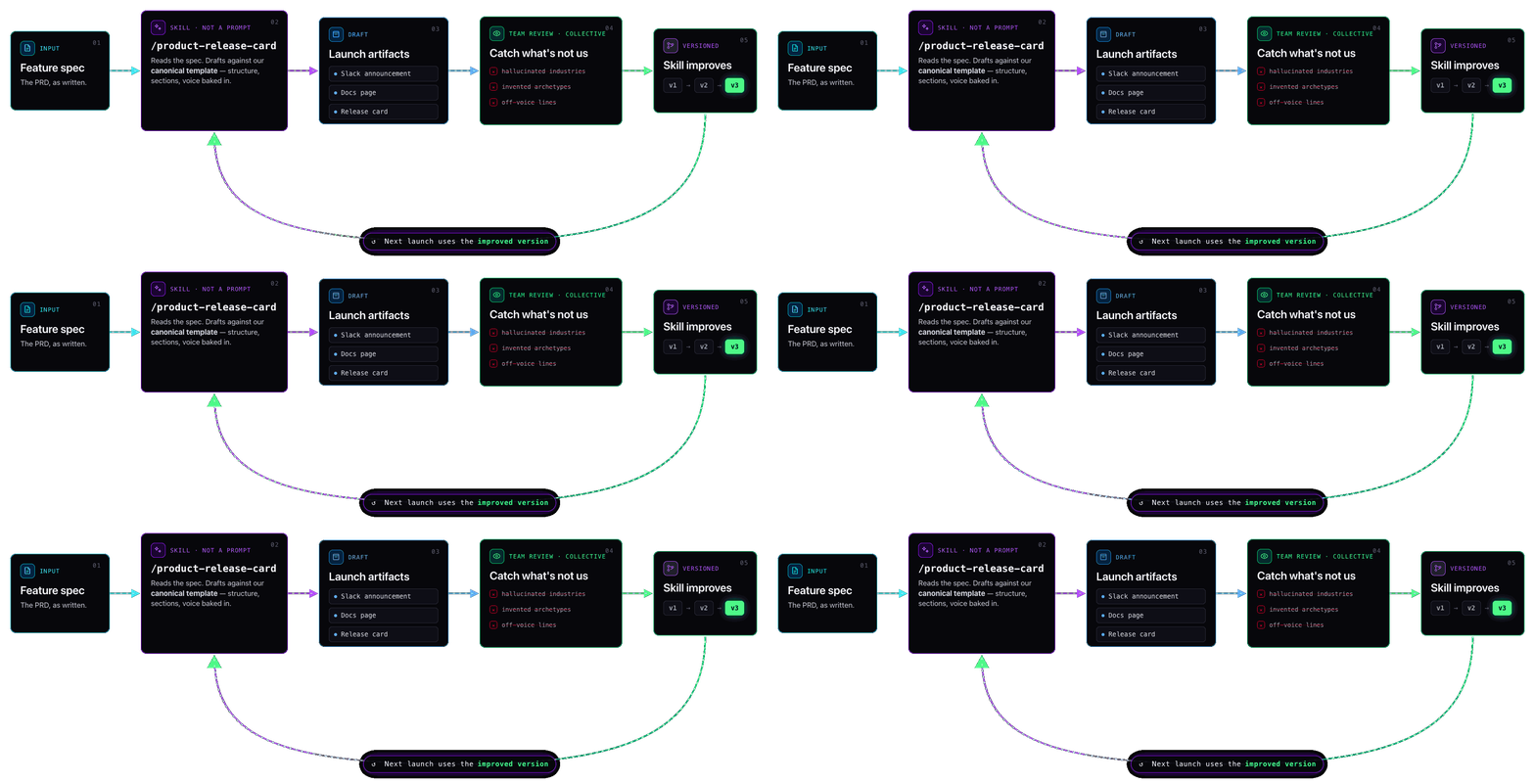
A prompt solves your problem once. A skill solves it for the team — forever.
Recap
Before and after — what changed.
Then · PM before AI
- PRD for a new product — roughly a week just for the analysis.
- Internal tools — mostly stuck in the "not now" backlog.
- Defects — every artefact hunted down by hand across systems, then manually pasted into the template.
- 30–40% of the day — routine, retyping the same thing in different formats.
Now · product engineer
- PRD — within 1–2 days.
- Internal tools — an MVP by evening.
- Defects — automation gathers the artefacts and drafts the fixes. I validate.
- 70%+ of the day — on decisions, so I take on things I never had time for before.
The delta isn't only speed. It's that I can now take on work that was never in my scope before.
Three things AI will definitely break.
01
Trade-offs between stakeholders.
Managing interests demands political instinct and memory of informal agreements.
02
Delegation Creep (creeping handover).
When AI nails 100 simple tasks in a row, an illusion of infallibility sets in. Oversight slips, and AI drifts onto the turf of strategic decisions. Responsibility doesn't delegate!
03
The intuitive "Smell Test".
The gut feeling that "something's off" even when the numbers add up but the context says otherwise. Experience and pattern-recognition against the machine. AI analyses the data it has — it doesn't have our intuition.
Golden rule: AI is flawless where there are "quality" examples. Blind trust = expensive mistakes.
Product Engineer — a reality.
…but only on three pillars.
-
01
AI in the SDLC isn't just coding in an IDE.
It's presence at every step of it. -
02
Invest in memory and context, not in prompts.
Prompts are one-shot. Context is the multiplier. -
03
Toolkit: AI + MCP + memory.
Without at least one of the tools — AI is just chat.
next step
Stay with us.
in 10 min · same stage
Panel:
Sr. PM × Sr. Engineering Manager × Head of AQA
Sr. PM × Sr. Engineering Manager × Head of AQA
How will AI change the SDLC?
take away
Copy my
vault-template.
vault-template.
Link to the starter template — in my LinkedIn bio.
linkedin.com/in/yehor-myroshnychenko